

How Restoration Professionals Repair Water-Damaged Flooring
Why Speed is Your Floor’s Best Friend After a Leak
Water and flooring are a particularly unforgiving combination. What appears on the surface as a stain, a soft spot, or a slight discoloration can represent something considerably more serious beneath — moisture that has moved into the subfloor, compromised the structural layer, or created the conditions for mold to develop where no one can see it.
Professional flooring restoration is not simply about making a floor look right again. It is about ensuring that what is underneath is stable, dry, and sound — because a floor that looks repaired but isn’t fully dried will continue to deteriorate long after the restoration team has left.
Understanding the damage before addressing it
The process begins with identifying where the water came from and how far it has traveled. Source identification matters because water that is still entering the structure — from a slow leak, ongoing moisture intrusion, or an unresolved plumbing issue — cannot be remediated until the source is controlled. Attempting to dry and restore flooring while the underlying cause remains active produces results that won’t last.
Once the source is confirmed, moisture testing establishes the actual condition of the floor and subfloor. Moisture meters and, where appropriate, infrared imaging reveal what is happening beneath the surface — how saturated the materials are, how far the moisture has spread, and whether the structural layer beneath the finish floor has been compromised. That information determines everything that follows.
Drying the structure, not just the surface
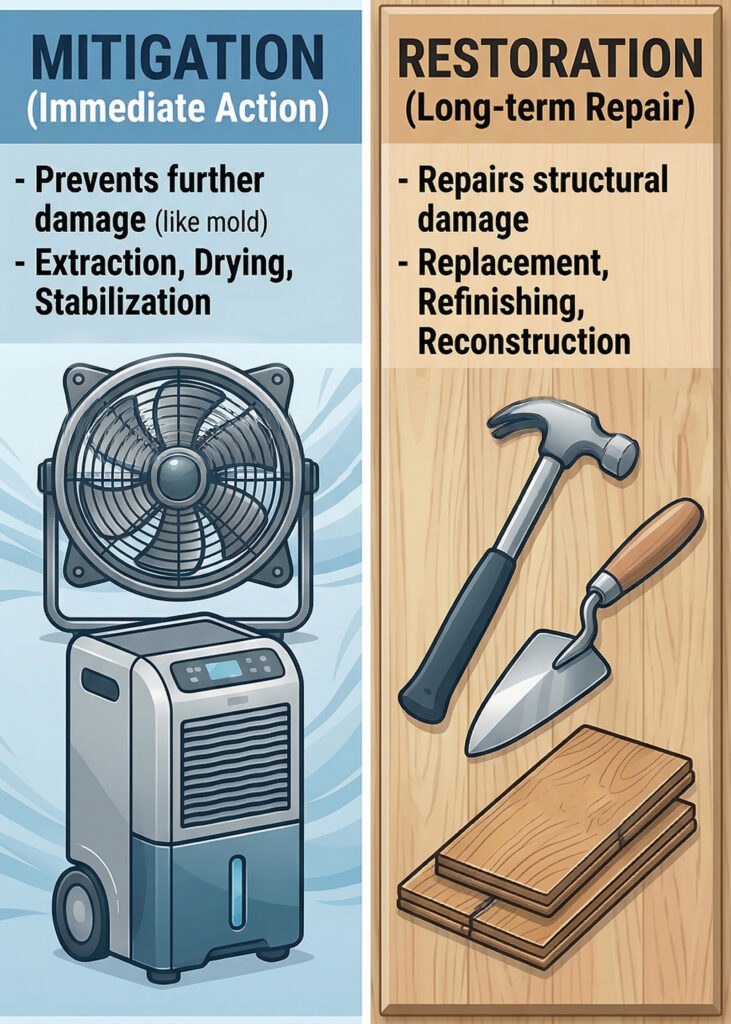
Surface moisture is the visible part of the problem. The more consequential moisture is what has absorbed into the flooring material itself and into the subfloor beneath it. Industrial air movers and commercial-grade dehumidifiers work together to draw that moisture out from both layers — a process that takes time and requires monitoring to confirm it is working as intended.
Rushing this step, or relying on equipment that isn’t suited to the task, leaves residual moisture in the structure. That residual moisture is what leads to warping, buckling, odor, and mold growth that shows up weeks after the initial damage appears to have been addressed.
Restoration or replacement, based on what the material can support
Not every water-damaged floor requires full replacement, and not every floor can be salvaged. The decision depends on the material, the extent of saturation, how long the moisture was present, and the condition of the subfloor.
Hardwood flooring that was exposed to moisture for a limited time and dried thoroughly can often be sanded, refinished, and restored to a condition that is structurally sound and visually consistent with the surrounding floor. Laminate, which is not designed to withstand moisture penetration, typically requires full removal and replacement once it has been saturated. Carpet that has been wet — particularly for more than a short period — carries a high risk of mold retention and usually cannot be salvaged.
Where replacement is necessary, matching materials to what exists in the surrounding area is part of the work. A repair that is structurally sound but visually inconsistent with the rest of the floor is only a partial solution.
Confirming the outcome before the work is complete
The final step is verification. Moisture levels are retested throughout the affected area — including in the subfloor and any adjacent flooring that may have been impacted — to confirm that drying is complete. Structural integrity is assessed to ensure that the repair will hold over time and not develop problems after the fact.
A floor that passes a visual inspection but hasn’t been formally verified for moisture content is not a finished restoration. It is a deferred problem. The confirmation step exists to make sure the work is genuinely complete, not just complete in appearance.
Water-damaged flooring is one of the more technically involved aspects of property restoration — because the consequences of getting it wrong don’t always show up immediately. East Coast Water Restoration approaches every flooring repair with the same methodology: find the full extent of the damage, dry it properly, restore or replace based on what the material can support, and verify the result before the job is closed.
If your flooring has been affected by water damage, contact our team. We’ll assess the situation thoroughly and make sure the repair holds.

Navigation
CONTACTS
- Address:
- 2844 Stirling Rd Suite S, Hollywood. FL 33020
© Copyrights 2026 Eastcoastrestorationpros.com | All Rights Reserved | Terms & Privacy